

I. EPC NR: scope and obligations
An EPC NR provides standardised and objective information on the energy performance of non-residential building units. Valid for five years, it guides building owners, developers and landlords towards carbon neutrality by identifying energy-saving measures. It also outlines necessary adjustments to meet renovation obligations.
The EPC NR applies to units used for non-residential purposes such as offices, retail spaces and hotels. Industrial buildings intended for production, processing, storage or handling of goods, such as warehouses and factories, are exempt from this obligation.
Such an EPC NR must be obtained in the case of a sale of a non-residential building unit, but also when granting (i) a long-term lease right, (ii) a building right and/or (iii) a lease right with regard to a non-residential building unit, as well as for large non-residential buildings (i.e. with a usable floor area of more than 500 m²), regardless of any transfer.
Renovation obligations are triggered only upon notarial transfer of full ownership rights and transfer of a long-term lease right or of a building right and consist of the achievement of a minimum package of measures related to roof insulation, window glazing, heating and cooling as well as at least the energy label E (i.e., a minimum of 5% renewable energy), within six years of the transfer.
II. The challenge of mixed-use logistics buildings
Logistics buildings typically combine industrial and non-residential uses, such as warehouses with integrated office spaces. This mixed-use nature complicates the determination of whether an EPC NR is required, and whether, in the case of transfer, the renovation obligations apply.
A. Previous 70%/30% rule
Prior to 1 January 2025, the so-called 70%/30% rule applied. If more than 70% of a building unit’s usable floor area was used for industrial purposes, the entire unit was considered industrial and thus exempt from EPC NR requirements, in case of transfer, from the related renovation obligations. This rule was based on the intended main use of the building unit.
B. New criteria that trigger EPC NR and renovation obligations
As of 1 January 2025, a more nuanced approach has been introduced in the inspection and measurement protocol for energy performance certificates for non-residential building units (inspectie-en meetprotocol energieprestatiecertificaat niet-residentieel). This inspection and measurement protocol issued by the Flemish Energy and Climate Agency (VEKA) is attached as annex 18/6 to the ministerial order dated 28 December 2018 and sets out the procedure that the energy experts must use when drawing up an EPC NR in the Flemish Region.
Therefore, since 1 January 2025, the 70%/30% rule is no longer the decisive factor in determining whether an EPC NR is required and whether renovations obligations are triggered upon transfer. The rule no longer automatically leads to a full exemption from EPC NR requirements and renovation duties.
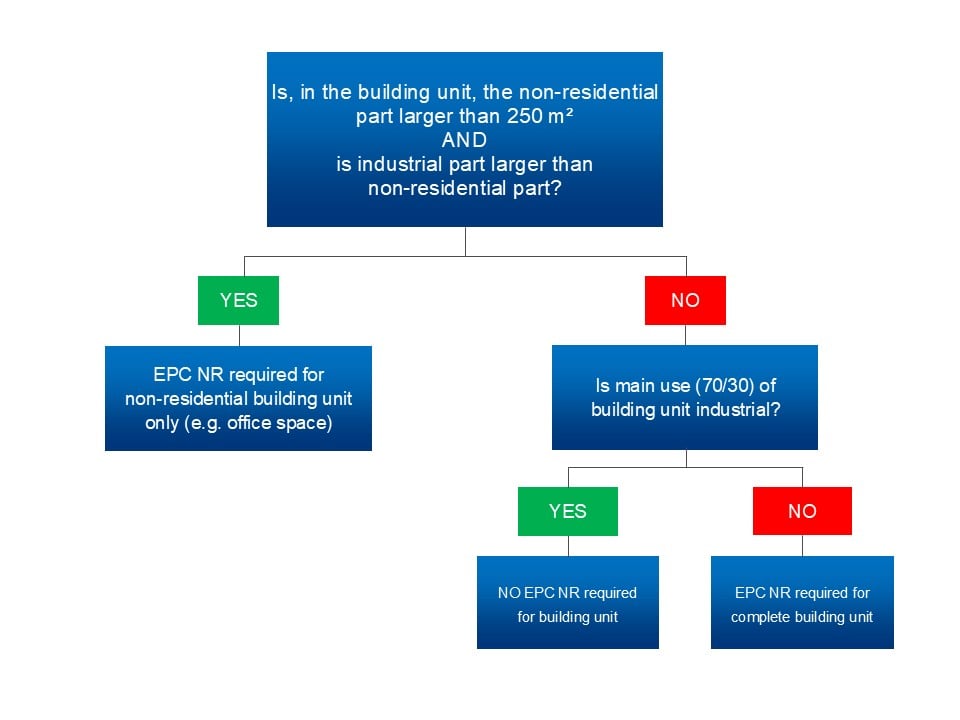
Instead, only the following two new criteria must be evaluated together:
- the non-residential area must have a usable floor area of more than 250 m²; and
- the (exempt) industrial area must be larger than the non‑residential area.
An EPC NR is required only if both conditions are cumulatively met, and only for the non‑residential part of the logistics building. The industrial part of the logistics building remains exempt, and renovation obligations apply exclusively to the non-residential part.
III. Implications for mixed-use logistics buildings
This means that simply identifying the property’s main use is no longer sufficient to determine whether a logistic asset qualifies for the industrial exemption. Even if the industrial unit exceeds 70% of the usable floor area, the integrated non-residential part may still require an EPC NR and trigger, upon transfer, renovation obligations.
If one of the conditions is not met, the building unit’s main use (hoofdbestemming) becomes the determining factor:
- if less than 70% of the total surface area is industrial, the EPC NR applies to the entire building unit, and the renovation obligations are triggered upon notarial transfer, with respect to the entire building unit.
- if more than 70% of the total surface area is industrial, the entire unit is exempt from the EPC NR requirements and from the renovation obligations.
The steps to be followed to determine whether an EPC NR is required, and the renovation obligations apply, in case of transfer, are outlined below:
Conclusion
The EPC NR obligations in the Flemish Region are becoming increasingly detailed and impactful, particularly for mixed-use logistics buildings. Therefore, a passive approach is no longer appropriate. The introduction of the new inspection and measurement protocol from 1 January 2025 marks a significant shift away from the previously straightforward 70%/30% rule. Building owners can no longer rely solely on the primary function of a property to determine EPC NR applicability.
Instead, a more nuanced, criteria-based approach now governs whether an EPC NR is required and whether renovation obligations are triggered. This means that even logistics buildings with a mixed use (office – industrial) may still be subject to EPC NR requirements for the non-residential parts if the non-residential area exceeds 250 m² and the if the industrial area is larger than the non-residential area.
Another key deadline to keep in mind is that as of 1 January 2030, all non-residential units (regardless of the surface area) falling under the cumulative conditions will need to comply with EPC NR requirements and achieve at least an E label.With this key deadline in 2030, it is essential for owners, developers, and landlords to proactively assess the specific characteristics of their logistics buildings to determine whether an EPC NR is required and whether, in case of transfer of their asset, the renovation obligations are triggered.
By 29 May 2026, the European Directive on Energy Performance of Buildings (the EPB-Directive) shall have to be implemented by the Member States, which will most likely reshape the rules of the game once again.
For questions, related to the application of new EPC NR requirements, please reach out to one of our lawyers below or to your trusted legal adviser at Loyens & Loeff.