4 minutes read
 Roel Duncker, Claire van der Hoeven
Access to the system under the Energy Act
The Energy Act regulates how projects may be connected to the electricity grid (under the Energy Act, a ‘grid’ is defined as a ‘system’). The basic principle is that every immovable property for tax purposes (a so-called ‘WOZ object’) must have its own connection to the system (at least, if the owner wishes the property to have access to the system). If different properties are interconnected by cables and infrastructure, there is a risk that a ‘system’ may be created unintentionally, for which, in principle, a system operator must be appointed. However, the Energy Act provides for three exceptions to the basic principle that each WOZ object must have its own connection for system access: cable pooling, the direct line and the closed system. In addition, it has recently become possible to enter into a group transport agreement: a form of virtual cable pooling. The key conditions for the four concepts are summarised in the table below.
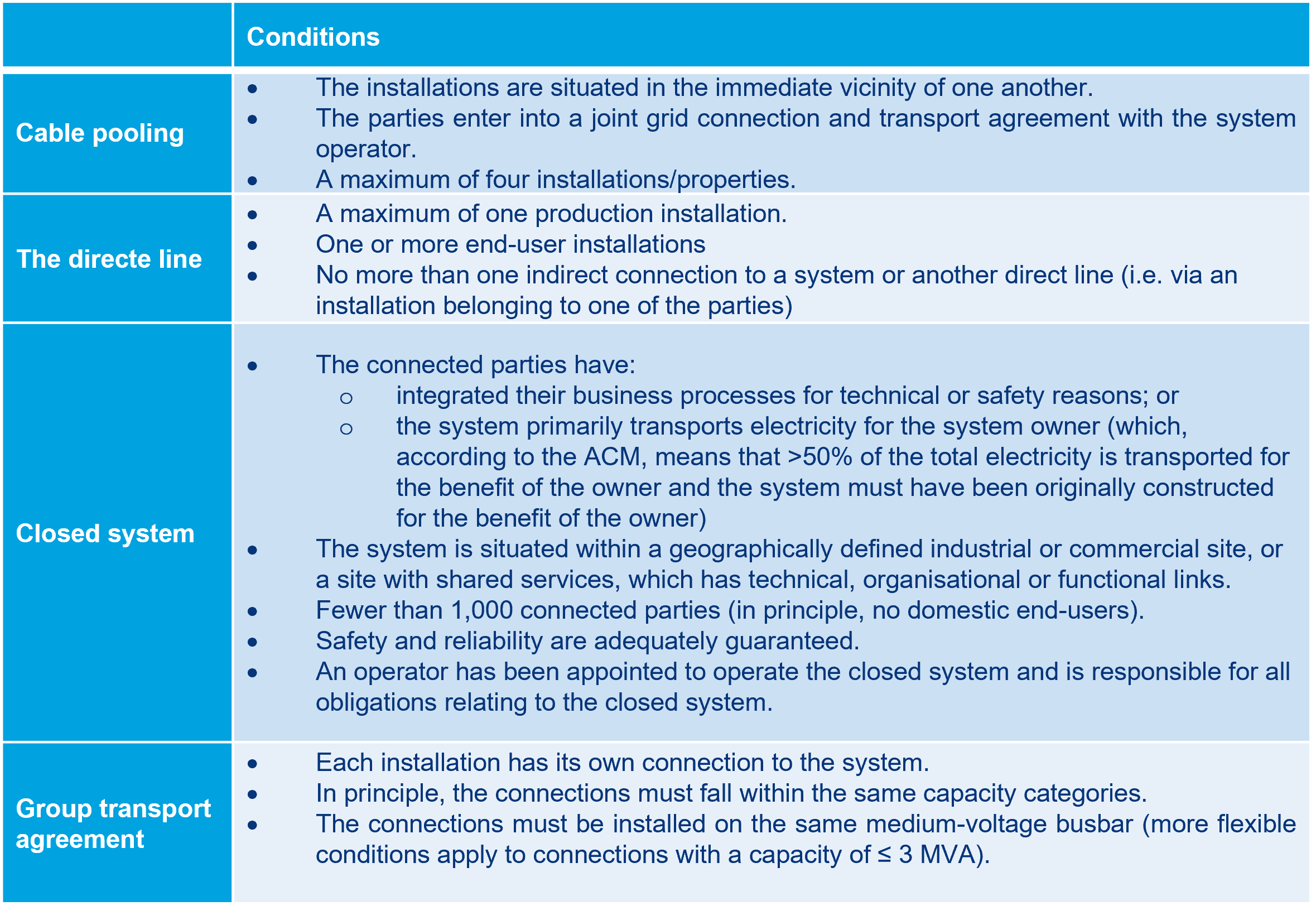
Cable pooling
Cable pooling makes it possible for up to four WOZ objects located in close proximity to one another to share a system connection. For many collaborative projects, cable pooling is sufficient: the maximum of four WOZ objects is more than ample for many such collaborations. As regards the criterion of ‘immediate proximity’, this is not strictly enforced in practice: cable routes of 3.5 km have been deemed sufficiently close by the ACM. However, cable pooling falls short when more than four installations need to be connected, or potentially when the installations are so far apart that they can no longer be said to be in each other’s immediate vicinity.
In cable pooling, the cooperating parties enter into a joint connection and transport agreement (CTA) with the system operator. Distribution system operators currently use a standard addendum to CTA to facilitate an accession. Compared to a structure in which only one party enters into the CTA with the system operator, a joint CTA has the advantage that, in principle, all parties have a direct contractual relationship with the system operator. In theory, this should reduce interdependencies, which is generally beneficial for the bankability of the projects acceding to the joint connection. Nevertheless, the standard addendum used by regional system operators is still relatively new and will need to be scrutinised by financiers. In practice, the parties will also need to enter into a ‘cable pooling agreement’ in which they set out all their mutual rights and obligations regarding the sharing of the connection.
A major commercial advantage of cable pooling is that it can lead to significant savings on transport fees. Consumption or storage taking place simultaneously with generation does not result in power being drawn from the grid, and therefore no transport fees are payable in respect of it. Consequently, cable pooling is not merely a means of continuing development despite congestion, but is, in many cases, commercially rational for batteries and consumers.
The direct line
The direct line is a facility that bears similarities to cable pooling. The direct line has its origins in the Electricity Directive, and EU Member States are obliged to facilitate the direct line in national law. The Dutch direct line is subject to the following requirements:
- The direct line consists of (a system of) cables and, where applicable, ancillary equipment (transformers, switches, etc.) that transport electricity from;
- A maximum of one production installation to;
- One or more end users (excluding domestic end users who are not employed by or have a similar relationship with the owner of the direct line);
- Is connected, via the installation of no more than one connected party, to a system or another transmission line (i.e. another direct line).
The direct line therefore makes it possible to connect one or more consumer installations to a single production installation, whereby the collective can be connected to the public system via a single participating installation. The concept of a direct line overlaps with cable pooling: a production installation engaged in cable pooling with up to three consumer installations can, in principle, also be classified as a direct line. However, there are also differences: the direct line is not limited to a maximum of four installations and may, in principle, bridge an unlimited distance between the installations. To date, the direct line has faced a number of obstacles that have made this facility less suitable for energy projects financed on a project basis.
Under the current Dutch regulations, the party to whom a system operator has granted access to the connection is classified as a ‘connected party’. Parties connected exclusively via the direct line therefore do not automatically have the same standing vis-à-vis the system operator as the primary connected party. This may raise questions regarding separate allocation points, market processes, choice of supplier and direct contractual rights vis-à-vis the system operator. Without appropriate arrangements, the parties involved may become dependent on the primary connected party for their energy contracting and the connection. This can lead to operational and legal complexity, for example when an electrolyser, battery and generation plant employ different trading and balancing strategies. This dependency also requires specific agreements regarding access, continuity, liability and security for project financing.
With the judgment of the European Court of Justice of 17 September 2026 (see our other blog: The Court of Justice’s direct line judgment: implications for the Netherlands), the Court has also removed some of these disadvantages of the Dutch direct line. The Court ruled that direct line customers are also entitled to access to the public system and to the right to freely choose a supplier. Consequently, a direct line customer should also be able to apply for a secondary allocation point, which significantly broadens their commercial operation opportunities and improves their bankability. The Court’s judgment also implies a broadening of the technical configuration options for a direct line: the condition for the Dutch direct line that it may have no more than one indirect connection to the system or to another direct line is not in accordance with the Electricity Directive. This also appears to broaden the technical configuration options for direct lines in the Netherlands. For the sake of completeness: the above has not (yet) been implemented in Dutch legislation and regulations, but parties may be able to rely on the European concept of a direct line and the provisions of the Electricity Directive even before implementation.
The closed system
The closed system, formerly known as the closed distribution system, is a fully-fledged system that may be managed privately. In principle, the closed system offers greater scope for connecting installations: up to 999 WOZ properties may be connected. This means that, in principle, large energy hubs can be created. However, the conditions for a recognition as a closed system are strict: there must be technical or safety reasons for operating a separate system (avoiding congestion is not a valid reason) or the closed system must primarily transport electricity for the system owner. Furthermore, a closed system requires a dedicated operator, which entails considerable administrative and operational responsibility. The closed system is therefore less suitable for smaller collaborative projects.
For large-scale collaborative projects, however, the closed system does offer advantages: by combining large-scale generation and storage with consumption within the closed system, significant savings can be made on the (high) transport fees of the public grid. Furthermore, a closed system creates a new, independent business case for the owner. New parties can be connected to the closed system under commercially negotiable terms, and revenue can be generated from connection and transport services (to which a lighter regulatory regime applies).
The group transport agreement
Finally, there remains the option of entering into a group transport agreement (GTA). Under specific conditions, the GTA offers connected parties the opportunity to share transport rights. Although no physical infrastructure is shared under a GTA, a GTA can nevertheless be regarded as a form of virtual cable pooling. For a GTA, it is a legal requirement that, in principle, members must be connected to the same substation of the system operator and that all connections must fall within the same connection capacity category. In practice, this is a strict requirement: for example, a factory with a 3 MVA connection will not be permitted to form a group with a wind or solar farm with an 11 MVA connection. In addition, each connected party must have its own connection to the substation’s busbar, meaning that a lack of connection points can also pose a practical obstacle. The conditions for a GTA are therefore somewhat stricter than those for cable pooling.
A potentially major advantage of the GTA for developers of renewable energy projects is that the system operator is responsible for realising the connection(s) (the full EPC). This differs from cable pooling, where developers themselves must realise a cable connection from the new project to a suitable point in the existing project’s infrastructure. For short distances, this need not be a problem, but if cables several kilometres long need to be laid, obtaining the necessary permits and private-law approvals can pose a major obstacle. System operators, however, have extensive experience in this area and can navigate the process efficiently. As the GTA imposes no further restrictions on the number of participants, it may also be particularly suitable for (owners of) business parks wishing to expand with new business premises. If the collaborating companies have complementary production and consumption profiles, they can share transport rights without having to (significantly) adjust their consumption. Even if this is not the case, sufficient capacity for everyone can be created by ensuring adequate generation and storage within the group. Such investments also make it possible to offer new business sites with firm transport capacity, despite grid congestion issues.
However, a GTA also has some disadvantages. Unlike cable pooling, direct lines and closed systems, a GTA does not result in savings on volume fees. All connected parties pay the full amount of volume fees, without simultaneous feed-in and off-take within the GTA being offset against one another. Although volume fees do not currently apply to connections at intermediate voltage and above (≥ 25 kV, including connections directly to the HV+MV/LV substation), in the summer of 2024 the ACM published a position paper in which it identified volume fees as a cost-reflective rate carrier for all voltage levels, suggesting a potential future change. This makes the GTA an option that offers added value only if cable pooling, direct lines and closed systems are not possible.
Furthermore, it is worth noting that the system operator does not simply add up all the individual contracted transport capacities to arrive at the group transport capacity, but instead looks at the highest historical combined peak. This means that entering into a GTA may result in the group transport capacity being lower than the sum of its parts. Finally, the GTA is a new standard agreement offered by system operators, and the parties will still need to draw up a ‘transport pooling agreement’ between themselves. Financiers have little to no experience in financing GTA arrangements. Securing financing for the GTA and the transport pooling agreement will require close coordination to ensure that all obligations and risks are adequately covered.
Summary and conclusion
The Energy Act provides for three different schemes enabling the shared use of the same infrastructure. In addition, the GTA offers the option of virtual use of the same infrastructure in specific cases. The shared use of the same infrastructure not only offers the possibility of gaining (or increasing) system access despite congestion, but is also, in many cases, more commercially advantageous than having a dedicated connection. For companies and developers, the choice of the appropriate facility will depend on the specific characteristics of the joint project. In making that choice, not only are the technical characteristics relevant (the number, nature and scale of the various installations), but certainly also the financial viability of the necessary cooperation agreements and the regulatory compliance analyses.
Legal and strategic advice on energy projects
Our energy team has extensive experience in the development of (renewable) energy projects. Using our own templates for, for example, cable pooling, transport pooling (at GTAs) and PPAs, we can efficiently draw up project documentation that is suitable for financing. In addition, our energy team has in-depth knowledge of all energy legislation, grid codes and trading on energy markets (spot, balancing and congestion markets), making us a strategic advisory partner in the early stages of project development.
Contact us
Are you curious about the ideal financing solution for your project? Please do not hesitate to contact us for an initial analysis, with no obligation.