3 minutes read
For providers and intermediaries of consumer credit, the implementation of the revised Consumer Credit Directive (CCD II) brings about far-reaching changes. The AFM is already processing licence applications, and there is now greater clarity regarding the application of the creditworthiness assessment, particularly for providers of ‘buy now, pay later’ (BNPL) and other newly regulated forms of credit. In Implementation Act Consumer Credit Directive II and Implementation Decree CCD II and consultation on the commission rules for consumer credit, we had already discussed the key points of the draft legislation as it stood at that time.
Licence applications are already possible
As the scope of the Financial Supervision Act (Wft) is being amended, new providers and intermediaries will fall under the supervision of the AFM. The AFM states that providers of deferred payment services (such as BNPL), deferred debit cards and hire or lease agreements with an option to purchase must assess whether they require a licence under Article 2:60 of the Wft.
Intermediaries in newly regulated forms of credit that do not fall under an exception, exemption or registration requirement require a licence under Article 2:80 of the Wft. Large undertakings that act as intermediaries in BNPL as a secondary activity are exempt from the licence requirement provided they are registered with the AFM.
The AFM has been processing licence applications since June 2026, in anticipation of the adoption and publication of the Implementation Act. The AFM states that its assessment may not yet fully reflect the new rules and that applications are made at the applicant’s own risk and expense. The licence will come into force once the Implementation Act enters into force.
Creditworthiness and proportionality
A letter sent to the House of Representatives on 22 September 2026 shows that the government confirms that Article 4:34 of the Financial Supervision Act (Wft) makes no distinction between different credit products, either under the current regime or following the implementation of CCDII. Credit providers must carry out a creditworthiness assessment for every credit application, regardless of whether it concerns a BNPL product, a credit card or a revolving credit facility. Nor is the type of product purchased with the credit relevant in this regard. The statutory standard therefore remains product-neutral and risk-based.
Many providers follow the VFN’s Lending Standards, which the AFM endorses as a minimum requirement. The Lending Standards currently apply to loans of EUR 1,000 or more with a term of more than three months. The VFN is reviewing the Lending Standards partly in light of the directive, with the proposed new provisions as follows:
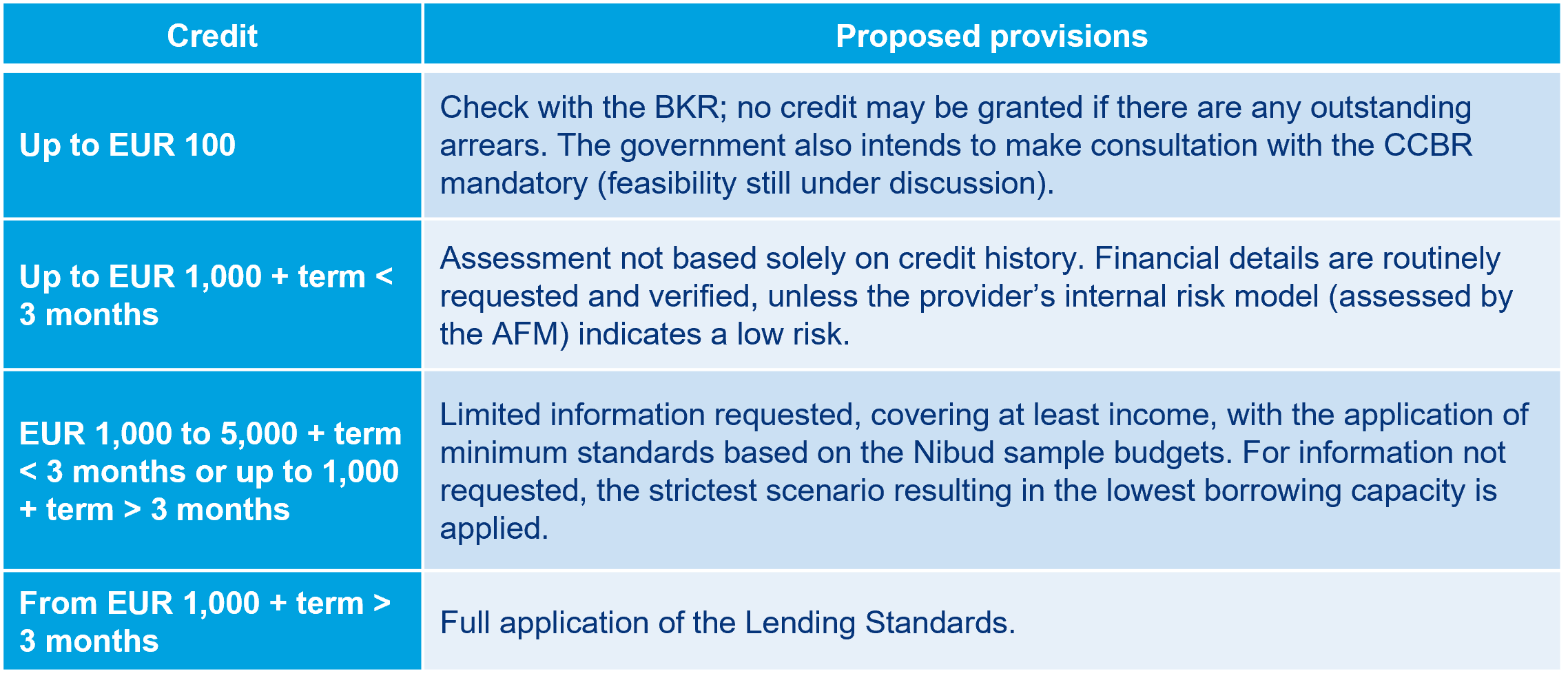
The Minister also points out that Belgium, Germany and France do not have a separate creditworthiness assessment for each credit product. In all three countries, the principle of proportionality is central. It is striking, however, that the Netherlands, with the proposed verification obligations and the planned BKR checks, appears to be going further than some other Member States.
The House of Representatives has adopted a motion calling on the government to organise the verification obligation in Article 113(1) of the Decree on the Conduct of Financial Undertakings (BGfo) in a risk-based manner. This is relevant because the Implementation Decree currently stipulates that all information requested must always be verified. The government must now amend Article 113 of the BGfo and the explanatory notes; until then, the current text remains in force. The motion to raise the threshold for the limited check from EUR 100 to EUR 150 was rejected. The threshold of EUR 100 therefore remains unchanged.
Motions adopted to amend the Implementation Act
In addition to the motions already mentioned, a large number of other motions have been tabled to amend the Implementation Act. Of particular relevance, for example, is the adoption of a motion on the basis of which the AFM will be requested to publish guidelines on the scope of the credit regime for common forms of payment and invoicing.
Furthermore, a number of motions have been adopted regarding ‘buy now, pay later’. For instance, a motion has been adopted to continue monitoring payment difficulties and problematic debts in relation to ‘buy now, pay later’ schemes. Should this development give cause to do so, the government has been asked to advocate at European level for a further tightening of the consumer credit framework, including, for example, the possibility of banning ‘buy now, pay later’ in physical shops and introducing a European minimum age for ‘buy now, pay later’. A motion has also been adopted to make a warning message mandatory at the checkout when using ‘buy now, pay later’ schemes.
Amendments to the Implementation Decree
The Implementation Decree has been under consideration by the House of Representatives since 12 June 2026. Compared with the consultation version, the Minister has amended the Implementation Decree on a number of points. For revolving credit, such as a credit card, the mandatory annual credit assessment is no longer required. Instead, a mandatory review policy will be introduced: providers will only be required to reassess a customer’s creditworthiness if there is cause to do so, for example if there are indications that the consumer’s financial situation has changed. In this way, the Minister aims to reduce the administrative burden whilst maintaining protection should the consumer’s financial situation deteriorate.
It has also been clarified that, in the event of a deferral of payment, credit providers may charge certain other fees in addition to the statutory costs, such as for replacing a card or an exchange rate surcharge. Furthermore, the scheme covers not only transfers to a bank account but also transfers to other accounts, such as a digital wallet or an investment account.
In addition, the AFM’s product intervention powers have been further elaborated. A new article contains a non-exhaustive list of factors that the AFM may use to assess whether a credit product is harmful to consumers and may therefore be withdrawn from the market, such as the complexity and transparency of the credit and the associated sales practices.
Finally, the provisions on fines have been supplemented: provisions relating to consumer protection, creditworthiness assessment and the early detection of payment difficulties – which were absent from the consultation draft – have now been designated as grounds for fines.
Current status
The bill will now go to the Senate. The Senate may pass the bill without debate or submit written questions, to which the government will respond in a memorandum of reply.
It is expected that the Implementation Act will not be published until at least 17 December 2026. This means that the entry into force date of 20 November 2026 will not be met. Although there has not yet been any formal communication from the AFM, it is expected that the AFM will take a lenient approach to compliance with the new rules during the first half of the year, given the limited clarity and awareness of the new standards in the market.
Contact
We would be happy to assist you in identifying the relevant changes for your organisation. Do you have any questions regarding this matter, or do you have queries about other topics relating to financial regulation? Please contact our Financial Regulatory Team.